
France is the 2nd largest producer of essential oils in Europe and even shows a trade surplus of +119 million euros for this product (source: INSEE, customs data 2020).
A performance that almost makes you forget the other side of the market: thousands of tons of exotic essential oils are also imported from India, China, Brazil, Indonesia, or Madagascar. They fuel price competition that drives the market down.
Whether you are a buyer or simply someone who wants to know what they put on their skin, the question remains the same:
Does the French origin really justify the price difference?
It’s not a simple “yes” without nuances. Here are 7 documented reasons with the real drawbacks for each.
1. Complete traceability, from the plant to the bottle
Know the exact origin of each plant
✅ A French essential oil can be traced back to the plot more easily.
✅ Region, municipality, harvest date, distiller included.
✅ For a buyer, this is a verifiable data point during a quality control or finished product certification.
❌ Not all French essential oils automatically do this.
❌ Some producers leverage this ambiguity. Plants are imported and distillation is done in France, for a “Made in France” without the ingredients.
Identifiable and verifiable producers
✅ Certification number verified by Ecocert, Bureau Veritas, or Certipaq.
✅ A more direct contact with the distiller without intermediaries, no call center.
✅ An opportunity to visit the production site.
❌ Small artisanal producers do not always have the resources for exhaustive documentation that larger orders may require.
❌ Obtaining an analysis report can take 2 to 5 business days. You need to anticipate if the deadline is tight.
[daf_cta]2. You know more precisely what you are buying and it is rarer than you think
Let’s take a real chromatographic analysis report. Every batch of a serious organic French essential oil comes with a document like this:
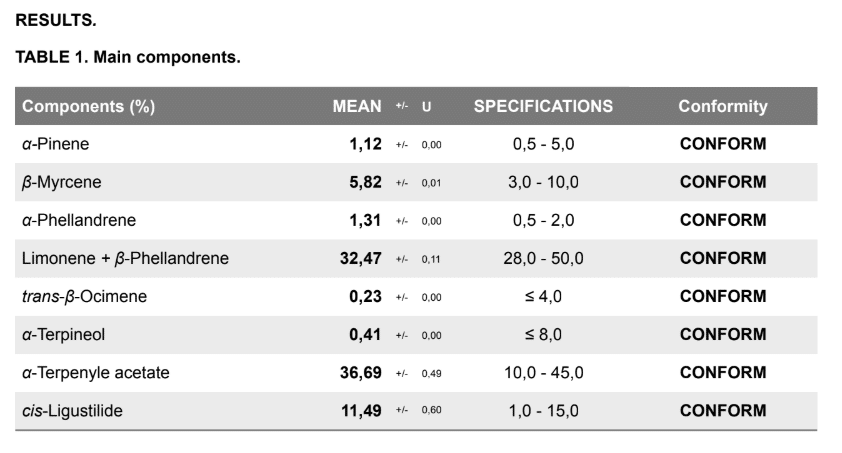
Each measured molecule is compared to the specifications of the technical data sheet. Here, all components are within the expected ranges: α-Pinene, β-Myrcene, Limonene, α-Terpinyl acetate, cis-Ligustilide: all compliant.
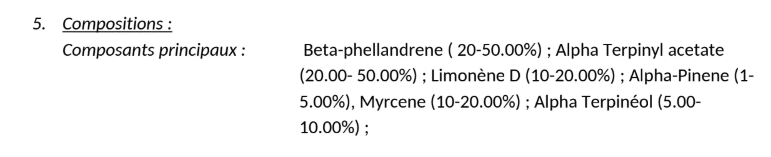
For imported oils, this level of documentation is rarer. The players are more fragmented: the producer, the distiller, and the analysis laboratory are often three distinct entities in three different countries.
✅ True lavender (Lavandula angustifolia) from Haute-Provence with an average of 38.4% linalool, 0.3% camphor is easier to distinguish from other imported species thanks to chromatographic analysis.
✅ Species like Italian immortelle from Corsica have a molecular profile linked to their terroir.
❌ Not all producers of French essential oils automatically provide these documents — they need to be requested explicitly.
3. Distillation processes that preserve active molecules
✅ Industrial import channels optimize volume, not the quality of active compounds per milliliter
✅ Steam passes through the plant matter without solvent, resulting in 100% pure essential oil, zero chemical residue
✅ Measurable result: the analysis report confirms that the molecular profile is intact
❌ A more concentrated French essential oil may require adjustments to reduce formulation
❌ An organic label does not guarantee the quality of distillation, the two are independent
❌ Poor distillation with a good French plant remains a poor essential oil
❌ Development costs need to be anticipated for brands relying on imports
4. Labels and certifications
✅ The designation HEBBD = Botanically and Biochemically Defined Essential Oil, unanimously defined in France.
✅ The Organic Agriculture certification (AB) is audited annually by a third-party organization
✅ For example, the AOC Lavender from Haute-Provence certifies the species, region, and distillation method.
✅ COSMOS Organic is a higher cosmetic standard than AB, which is also used for our French origin oils.
❌ HEBBD is not a regulated label, it is a commercial designation.
❌ It can appear on a label without third-party certification body. Always check who certifies it.
❌ COSMOS is not yet widespread in the French essential oil sector
❌ An essential oil can be organic and of poor quality if the distillation is botched
5. Direct support for short circuits and the local industry
✅ It’s a mark of quality for your end consumer: 74% of French people would be willing to pay more for “Made in France” (IFOP 2018)
✅ Each eliminated intermediary or wholesaler = a margin removed + preserved traceability information.
✅ For buyers, tripartite contracts between the producer, the distiller, and themselves are conceivable for greater predictability of upcoming stocks.
✅ Each order maintains cultivated areas, rural jobs, and distillation know-how.
❌ An artisanal producer cannot always absorb large volumes on short notice.
❌ Large orders often require planning 1 year in advance.
❌ French true lavender costs 2 to 3 times the price of a “lavender” from Bulgaria.
❌ This difference is real. It is justified by the data but must be accepted in your product cost structure.
6. A reduced and measurable environmental impact
The carbon calculation that disturbs
✅ An essential oil produced in Provence travels ~400 km to Paris, while an essential oil imported from China travels 9,000 to 12,000 km by sea.
✅ The plant residues from distillation can be transformed into biochar, carbon sequestered for at least 100 years. The EBC (European Biochar Certificate) generates verifiable carbon credits.
❌ Transportation only accounts for part of the total footprint
❌ Agricultural practices and the heating method of the distillery count just as much.
❌ “Made in France” does not guarantee decarbonized production (e.g., if the distillery runs on fuel oil)
❌ The biochar carbon credit market is still emerging with an economic value that remains variable
7. Some of the strictest health standards in the world
European regulation: a constraint that protects
✅ ISO standards, European pharmacopoeia, REACH, cosmetic regulation 1223/2009.
✅ Inspections are systematic and the penalties are real.
✅ In France, there are 61,613 certified organic farms (2nd largest area of organic farming in Europe) (FiBL data 2023)
✅ In 2023, France had 4,866 organic PPAM producers, showing a 4.5% increase compared to 2022. Lavender and lavandin account for more than half of the organic PPAM area. The growth dynamic is indeed real and consistent with the general trend of local essential oils. (Bio Cluster, 2024)
✅ Organic guarantees the absence of detectable synthetic pesticide residues, traceability of agricultural inputs, and the separation of organic and conventional flows verified by annual audit.
❌ Producers outside the EU may also be subject to the same obligations.
❌ Even organic, an essential oil remains a powerful molecular concentrate. The origin does not eliminate the precautions for use.
Sources:
INSEE. (2022). External trade of France — Customs data 2020.
National Institute of Statistics and Economic Studies.
https://www.insee.fr/fr/statistiques/6434102#onglet-2
IFOP for the Observatory of Made in France. (2018). The French and the
Made in France. IFOP.
FiBL & IFOAM. (2024). Nearly 11% of the agricultural land in the EU is cultivated
in organic farming. Research Institute of Organic Agriculture.
https://www.fibl.org/fr/infotheque/message/pres-de-11-surface-agricole-ue-
cultivee-en-bio
Cluster Bio. (2024). The organic sectors — Organic PPAM. Cluster Bio
Auvergne-Rhône-Alpes. https://www.cluster-bio.com/fr/ecosysteme/les-filier
es-du-bio/filieres-ppam-bio/