
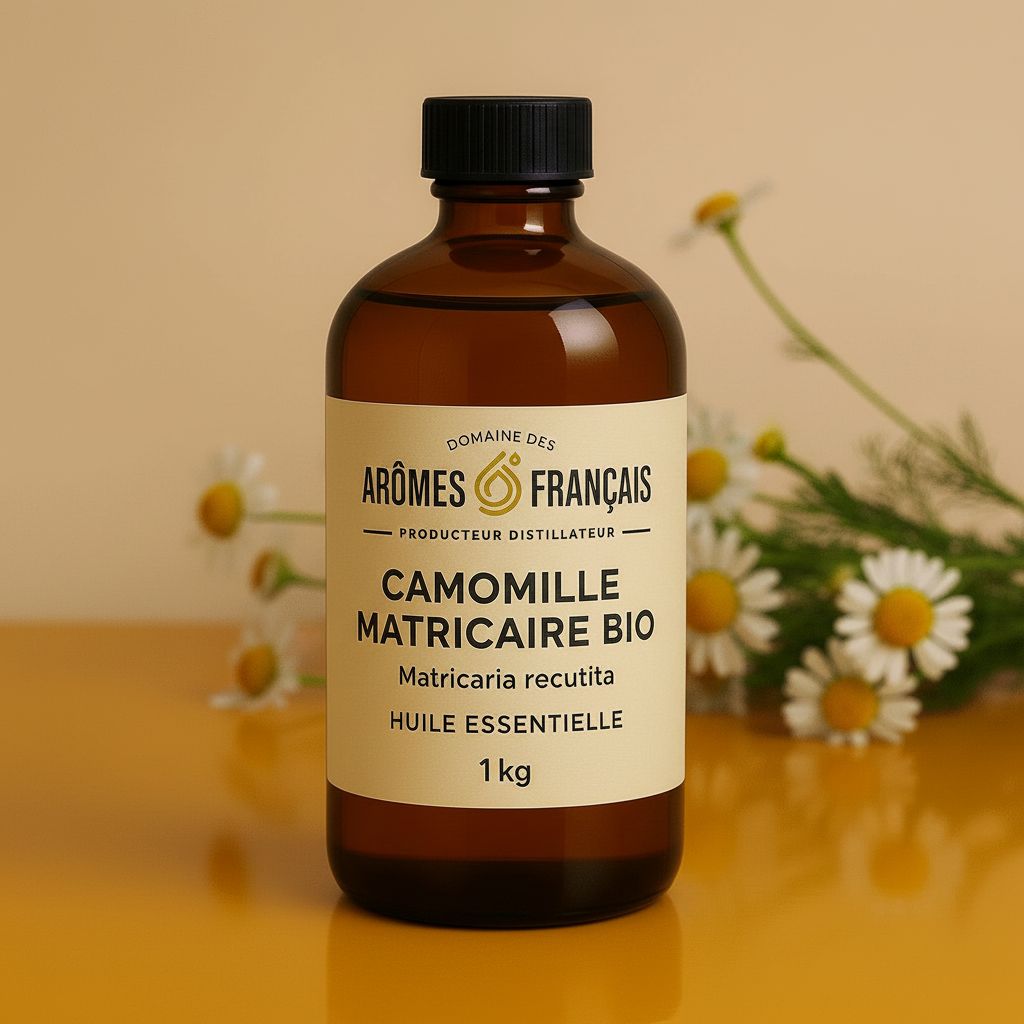
GERMAN CHAMOMILE

Need more? Please submit a custom quote request. We will get back to you within 24 hours.
The German chamomile, also called blue chamomile, produces an essential oil renowned for its powerful anti-inflammatory and soothing properties.
Its characteristic blue color reflects its richness in soothing compounds: it effectively relieves irritations of the skin and mucous membranes while promoting nervous and digestive relaxation.
A TRULY FRENCH ORIGIN
Grown in France, the plants from our producers are distilled either in the Drôme Provençale (fixed distillery unit), or directly in the harvest field (mobile distillery unit), then packaged in our warehouse in Isère.
Each batch is traced from the plot to the bottle, with analyses conducted by a French laboratory.
A LOCAL ALTERNATIVE
This locally grown plant can represent a relevant alternative to popular exotic essential oils.
Despite their natural origin, these can have a significant environmental impact (deforestation, pressure on biodiversity, carbon-intensive transport).
Here is an example:
The tea tree generally offers a broader antimicrobial spectrum, while German chamomile stands out for its powerful soothing effect on sensitive skin inflammations.
Please note: Each essential oil has a unique identity, and the same plant can also vary depending on its origin. The equivalences proposed here do not aim to fully replace exotic plants, but to explore complementary alternatives based on your needs.
This comparison is part of an approach to promote Made in France and Made in Europe products, while encouraging responsible use of oils sourced from fragile ecosystems such as Tea Tree or Ylang-Ylang.
Complete Plant Identity
QUALITY GUARANTEES
- 100% pure, natural, undiluted.
- Certified ORGANIC by Ecocert (FR-BIO-01)
- HECT (French chemotyped essential oil standard)
- Conform to EOBBD (Essential Oil Botanically and Biochemically Defined)
- Certificate of Analysis (CoA) included via Gas Chromatography/Mass Spectrometry (GC/MS)
PLANT CHEMICAL PROFILE
Safety Data Sheets (SDS) and technical data sheets are available in French only. For a personalised translation, feel free to contact us.
MOLECULAR PROPERTIES
WHO IS THIS oil FOR?

COSMETICS
- Sensitive skin care: anti-redness creams and lotions, soothing and anti-irritation products.
- Hair care: clarifying shampoos and lotions for blonde hair.
- Dermatological products: creams, ointments or mouthwashes to relieve inflammation of the skin and mucous membranes.

PHARMACIES
- Digestive specialties: herbal teas, extracts or capsules based on chamomile to treat dyspepsia and spasmodic colitis.
- Dermatological care: incorporating chamomile to relieve inflammation.
- Mild sedatives: syrups or soothing infusions based on chamomile to reduce nervousness.

FOOD INDUSTRY
- Possible use as a natural flavor or dietary supplement under certain strict conditions.
AROMATHERAPY
- Inflammatory skin conditions – in diluted topical application to soothe eczema and itching.
- Digestive disorders – in abdominal massage or supervised internal use.
- Sleep disturbances and stress – in diffusion or inhalation.
Usage guidelines
Not recommended for:
- Children under 7 years old
- Pregnant / breastfeeding women
- Epileptics
- Asthmatics
Essential oils are not without risks:
- Prior skin patch test recommended
- Never ingest undiluted without consulting a healthcare professional.
- Risks: allergy, convulsion, irritation, respiratory toxicity
Logistics
- 1 kg bottle: 24 × 9 × 9 cm
- 5 kg jerrycan: 28 × 18 × 23 cm
- 10 kg jerrycan: 32 × 23 × 29 cm
Please note:
Bulk orders are non-returnable, non-exchangeable, and non-refundable, except in the event of damage during transport.
If you suspect a quality issue with a bulk order, please contact our team within 30 days.
A 10 ml sample can be requested for analysis.
Any questions? Feel free to contact us:
+33 6 13 80 34 13
contact@domainedesaromesfrancais.com.
SHIPPING COSTS
France :
Mondial Relay : 14,95 €
Colissimo : 14,95 €
DHL : 24,95 €
Europe :
Mondial Relay : 15,95 €
Colissimo : 15,95 €
DHL : 25,95 €
SAFETY
Flammable, irritant, potentially toxic by inhalation or ingestion
Toxic to aquatic organisms


Sources :
The information presented above is provided for informational purposes only and cannot replace the advice of a healthcare professional.
- De Cicco, P., Ercolano, G., Sirignano, C., Rubino, V., Rigano, D., Ianaro, A., & Formisano, C. (2023). Chamomile essential oils exert anti-inflammatory effects involving human and murine macrophages: Evidence to support a therapeutic action. Journal of Ethnopharmacology, 311, 116391. https://doi.org/10.1016/j.jep.2023.116391
- McKay, D. L., & Blumberg, J. B. (2006). A review of the bioactivity and potential health benefits of chamomile tea (Matricaria recutita L.). Phytotherapy Research, 20(7), 519–530. https://doi.org/10.1002/ptr.1900
- Singh, O., Khanam, Z., Misra, N., & Srivastava, M. K. (2011). Chamomile (Matricaria chamomilla L.): An overview. Pharmacognosy Reviews, 5(9), 82–95. https://doi.org/10.4103/0973-7847.79103
- Wikipédia. (n.d.). Camomille matricaire. Dans Wikipédia. Consulté le 8 août 2025, depuis https://fr.wikipedia.org/wiki/Camomille_matricaire
- Myrtea Formations. (2020). Huile essentielle de Matricaria recutita (camomille matricaire) [Fiche monographique longue]. https://www.myrtea-formations.com/modules/aromatheque/Fichiers_pdf/Monographies_longues/HE-Matricaria_recutita.pdf
- Ecotoxicologie.fr. (n.d.). Camomille matricaire – Fiche toxicologique. Consulté le 8 août 2025, depuis https://www.ecotoxicologie.fr/camomille-matricaire