
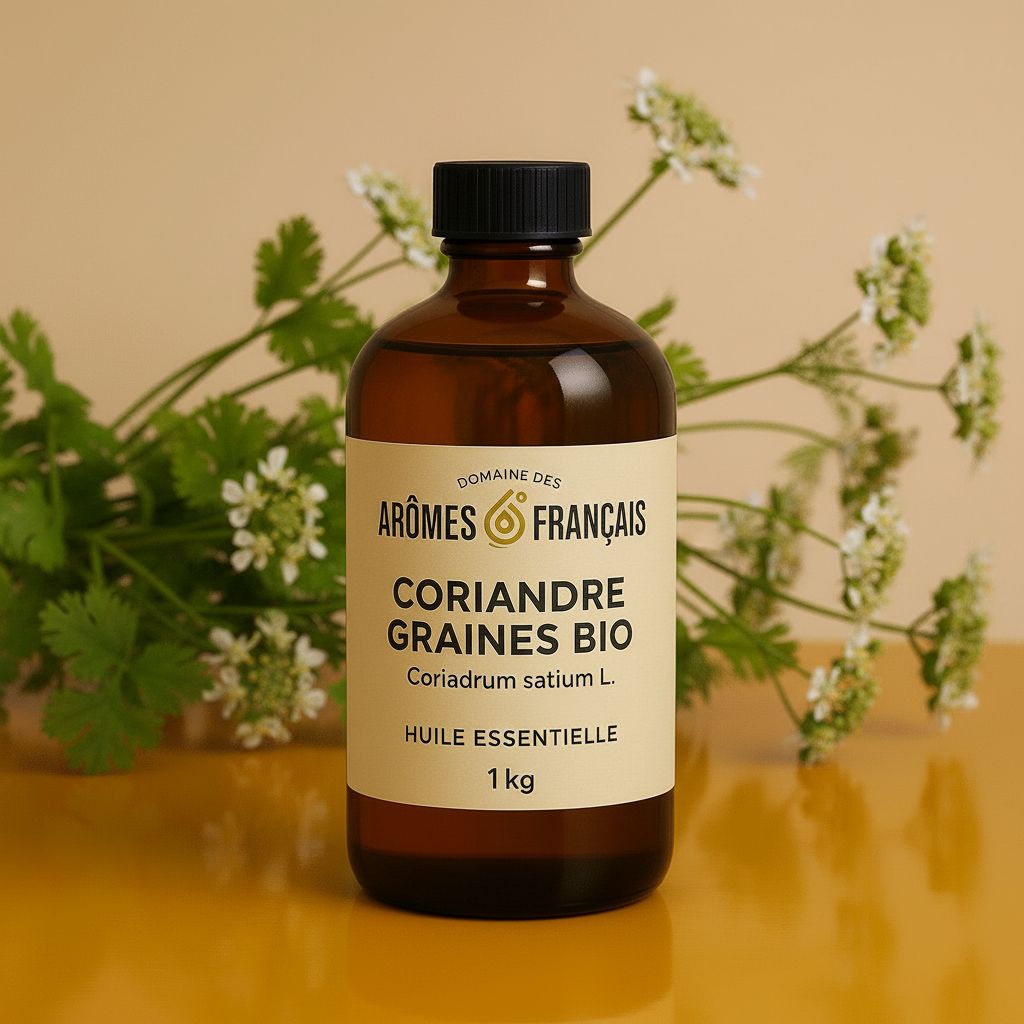
CORIANDER SEEDS

Need more? Please submit a custom quote request. We will get back to you within 24 hours.
Coriander seed essential oil is distinguished by its exceptional richness in linalol (60-75%), conferring digestive, antispasmodic and antimicrobial properties scientifically validated.
Unlike the more aldehyde-rich leaves, this essence derived from ripe fruits offers a soft aromatic profile, musky and spicy, ideal for professional formulations in pharmacy, cosmetics and aromatherapy.
A TRULY FRENCH ORIGIN
Grown in France, the plants from our producers are distilled either in the Drôme Provençale (fixed distillery unit), or directly in the harvest field (mobile distillery unit), then packaged in our warehouse in Isère.
Each batch is traced from the plot to the bottle, with analyses conducted by a French laboratory.
A LOCAL ALTERNATIVE
This locally grown plant can represent a relevant alternative to popular exotic essential oils.
Despite their natural origin, these can have a significant environmental impact (deforestation, pressure on biodiversity, carbon-intensive transport).
Here is an example:
Tea Tree (Melaleuca alternifolia) possesses a very broad antimicrobial spectrum, particularly effective on skin (acne, infected wounds) and in oral hygiene. Coriander, although less versatile in topical application, demonstrates notable efficacy against digestive infections.
Please note: Each essential oil has a unique identity, and the same plant can also vary depending on its origin. The equivalences proposed here do not aim to fully replace exotic plants, but to explore complementary alternatives based on your needs.
This comparison is part of an approach to promote Made in France and Made in Europe products, while encouraging responsible use of oils sourced from fragile ecosystems such as Tea Tree or Ylang-Ylang.
Complete Plant Identity
QUALITY GUARANTEES
- 100% pure, natural, undiluted.
- Certified ORGANIC by Ecocert (FR-BIO-01)
- HECT (French chemotyped essential oil standard)
- Conform to EOBBD (Essential Oil Botanically and Biochemically Defined)
- Certificate of Analysis (CoA) included via Gas Chromatography/Mass Spectrometry (GC/MS)
PLANT CHEMICAL PROFILE
Safety Data Sheets (SDS) and technical data sheets are available in French only. For a personalised translation, feel free to contact us.
MOLECULAR PROPERTIES
WHO IS THIS oil FOR?

COSMETICS
- Anti-aging and regenerating skincare (serums, creams) leveraging the healing properties of linalol
- Soothing products for sensitive, reactive skin (lotions, balms, calming emulsions)
- Fine and functional fragrances (deodorants, eau de toilette) for its natural powdery-spicy notes

PHARMACIES
- Galenic formulations for functional digestive disorders (gastro-resistant capsules, oral solutions)
- Antifungal dermatological preparations (creams, gels at 2-6% for intertrigo, superficial mycoses)
- Mild antiseptic solutions for intimate or oral hygiene, compatible with other pharmaceutical active ingredients

FOOD INDUSTRY
- Possible use as a natural flavoring in digestive liqueurs, confectionery, bakery and pastry products.
- Strict compliance with food dosage levels (a few ppm maximum) and FEMA-GRAS regulations.
- Prefer hydrolat for common food applications.
AROMATHERAPY
- Excellent in synergy with fine lavender, petitgrain bigarade or Roman chamomile for sleep disorders and digestive anxiety.
- Dilution 2-5% in vegetable oil for post-prandial abdominal massage or application to solar plexus in case of stress.
Usage guidelines
Not recommended for:
- Children under 7 years old
- Pregnant / breastfeeding women
- Epileptics
- Asthmatics
Essential oils are not without risks:
- Prior skin patch test recommended
- Never ingest undiluted without consulting a healthcare professional.
- Risks: allergy, convulsion, irritation, respiratory toxicity
Logistics
- 1 kg bottle: 24 × 9 × 9 cm
- 5 kg jerrycan: 28 × 18 × 23 cm
- 10 kg jerrycan: 32 × 23 × 29 cm
Please note:
Bulk orders are non-returnable, non-exchangeable, and non-refundable, except in the event of damage during transport.
If you suspect a quality issue with a bulk order, please contact our team within 30 days.
A 10 ml sample can be requested for analysis.
Any questions? Feel free to contact us:
+33 6 13 80 34 13
contact@domainedesaromesfrancais.com.
SHIPPING COSTS
France :
Mondial Relay : 14,95 €
Colissimo : 14,95 €
DHL : 24,95 €
Europe :
Mondial Relay : 15,95 €
Colissimo : 15,95 €
DHL : 25,95 €
SAFETY
Flammable, irritant, potentially toxic by inhalation or ingestion
Toxic to aquatic organisms


Sources :
The information presented above is provided for informational purposes only and cannot replace the advice of a healthcare professional.
- Wikiphyto. (1998). Coriandre. *Wikiphyto - Encyclopédie phytothérapeutique*. Consulté le 8 septembre 2025, https://www.wikiphyto.org/wiki/Coriandre
- Vidal. (2011). Huile essentielle de coriandre : vers de nouveaux antiseptiques ? *Vidal Actualités*. https://www.vidal.fr/actualites/18126-huile-essentielle-de-coriandre-vers-de-nouveaux-antiseptiques.html
- Silva, F., Ferreira, S., Queiroz, J. A., & Domingues, F. C. (2011). Coriander (Coriandrum sativum L.) essential oil: its antibacterial activity and mode of action evaluated by flow cytometry. *Journal of Medical Microbiology*, 60(10), 1479-1486.
- Casetti, F., Bartelke, S., Biehler, K., Augustin, M., Schempp, C. M., & Frank, U. (2011). Antimicrobial activity against bacteria with dermatological relevance and skin tolerance of the essential oil from Coriandrum sativum L. fruits. *Phytotherapy Research*, 26(3), 420-424.
- Belmeziti, F., & Sebaihi, S. (2022). Études chimique et biologique des huile essentielle des graines de la coriandre. *Mémoire Master Sciences Biologiques*, Université de Bordj Bou Arreridj. http://dspace.univ-bba.dz/handle/123456789/2752
- Mandal, S., & Mandal, M. (2015). Coriander (Coriandrum sativum L.) essential oil: Chemistry and biological activity. *Asian Pacific Journal of Tropical Biomedicine*, 5(6), 421-428.