
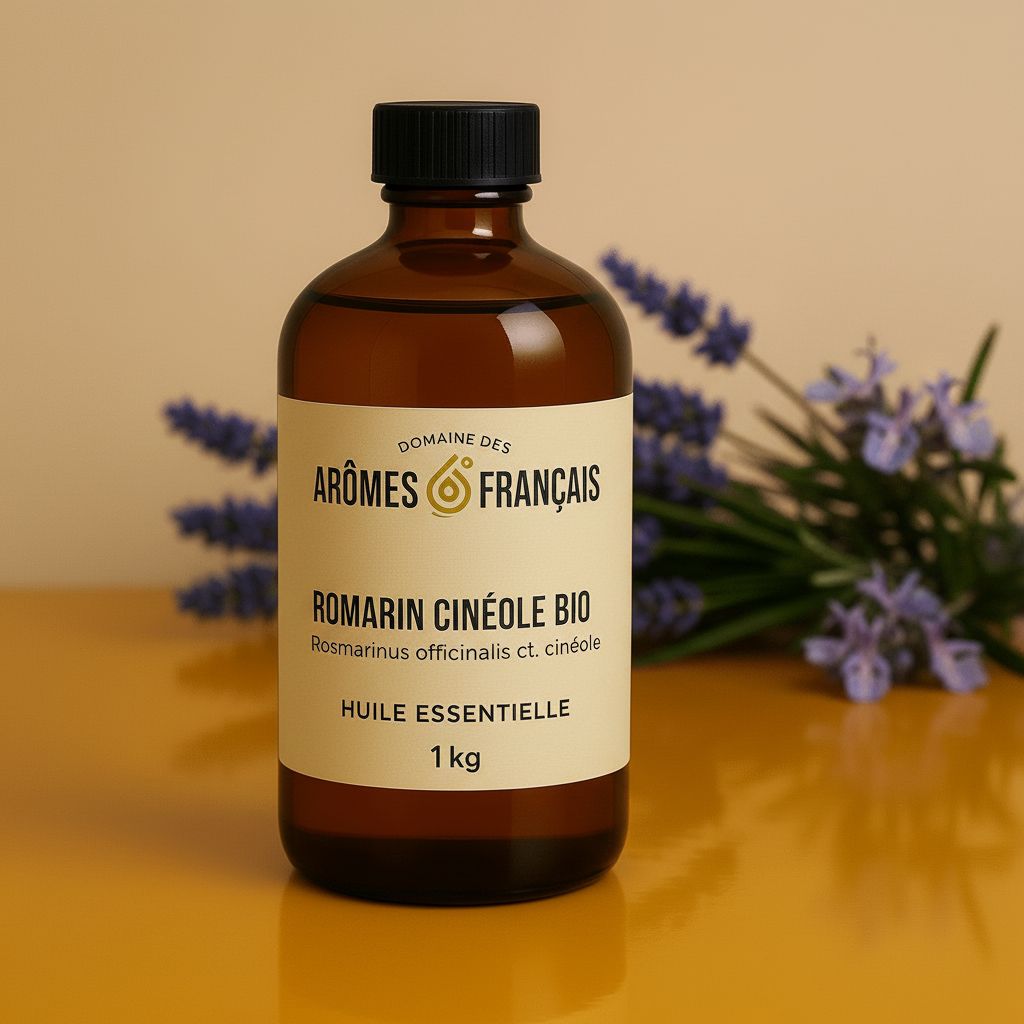
ROSEMARY CINEOLE

Need more? Please submit a custom quote request. We will get back to you within 24 hours.
Rosemary cineole essential oil is recognized as an exceptional cognitive and respiratory stimulant.
Rich in 1,8-cineole, it excels in the treatment of bronchopulmonary conditions and the enhancement of mental performance.
This French alternative to exotic essences combines therapeutic efficacy and local traceability for healthcare professionals.
A TRULY FRENCH ORIGIN
Grown in France, the plants from our producers are distilled either in the Drôme Provençale (fixed distillery unit), or directly in the harvest field (mobile distillery unit), then packaged in our warehouse in Isère.
Each batch is traced from the plot to the bottle, with analyses conducted by a French laboratory.
A LOCAL ALTERNATIVE
This locally grown plant can represent a relevant alternative to popular exotic essential oils.
Despite their natural origin, these can have a significant environmental impact (deforestation, pressure on biodiversity, carbon-intensive transport).
Here is an example:
Eucalyptus globulus, very rich in 1,8-cineole (70-80%), offers more intense action on the lower respiratory tract than cineole rosemary.
It excels particularly in bronchitis and pulmonary infections thanks to its superior mucolytic power.
However, cineole rosemary presents the advantage of better skin tolerance and stimulating cognitive effects that eucalyptus does not possess, thus offering broader therapeutic versatility.
Please note: Each essential oil has a unique identity, and the same plant can also vary depending on its origin. The equivalences proposed here do not aim to fully replace exotic plants, but to explore complementary alternatives based on your needs.
This comparison is part of an approach to promote Made in France and Made in Europe products, while encouraging responsible use of oils sourced from fragile ecosystems such as Tea Tree or Ylang-Ylang.
Complete Plant Identity
QUALITY GUARANTEES
- 100% pure, natural, undiluted.
- Certified ORGANIC by Ecocert (FR-BIO-01)
- HECT (French chemotyped essential oil standard)
- Conform to EOBBD (Essential Oil Botanically and Biochemically Defined)
- Certificate of Analysis (CoA) included via Gas Chromatography/Mass Spectrometry (GC/MS)
PLANT CHEMICAL PROFILE
Safety Data Sheets (SDS) and technical data sheets are available in French only. For a personalised translation, feel free to contact us.
MOLECULAR PROPERTIES
WHO IS THIS oil FOR?

COSMETICS
- Stimulating hair care: anti-hair loss shampoos and lotions to activate scalp microcirculation and strengthen weakened hair.
- Purifying products: cleansers for combination to oily skin, astringent tonics to tighten pores and regulate excess sebum.
- Revitalizing cosmetics: energizing creams and invigorating massage oils to improve skin radiance and stimulate tissues.

PHARMACIES
- Respiratory formulations: chest rubs, expectorant syrups, decongestant suppositories for treating bronchitis, sinusitis and ENT infections.
- Cognitive preparations: capsules or solutions to improve concentration and memory, particularly in seniors with mild cognitive impairment.
- Dermatological products: antiseptic lotions, wound-healing creams for minor wounds thanks to antimicrobial properties.

FOOD INDUSTRY
- Internal use is possible but strictly regulated.
- It can serve as a natural flavoring in infinitesimal quantities (1 drop per large volume) in culinary preparations.
AROMATHERAPY
- This essential oil is ideal for diffusion to stimulate cognitive functions (2-3 drops in a diffuser)
- in inhalation to clear the respiratory tract
- and in diluted topical application at 10% in a carrier oil.
Usage guidelines
Not recommended for:
- Children under 7 years old
- Pregnant / breastfeeding women
- Epileptics
- Asthmatics
Essential oils are not without risks:
- Prior skin patch test recommended
- Never ingest undiluted without consulting a healthcare professional.
- Risks: allergy, convulsion, irritation, respiratory toxicity
Logistics
- 1 kg bottle: 24 × 9 × 9 cm
- 5 kg jerrycan: 28 × 18 × 23 cm
- 10 kg jerrycan: 32 × 23 × 29 cm
Please note:
Bulk orders are non-returnable, non-exchangeable, and non-refundable, except in the event of damage during transport.
If you suspect a quality issue with a bulk order, please contact our team within 30 days.
A 10 ml sample can be requested for analysis.
Any questions? Feel free to contact us:
+33 6 13 80 34 13
contact@domainedesaromesfrancais.com.
SHIPPING COSTS
France :
Mondial Relay : 14,95 €
Colissimo : 14,95 €
DHL : 24,95 €
Europe :
Mondial Relay : 15,95 €
Colissimo : 15,95 €
DHL : 25,95 €
SAFETY
Flammable, irritant, potentially toxic by inhalation or ingestion
Toxic to aquatic organisms


Sources :
The information presented above is provided for informational purposes only and cannot replace the advice of a healthcare professional.
- Dhakad, A. K., Pandey, V. V., Beg, S., Rawat, J. M., & Singh, A. (2018). Biological, medicinal and toxicological significance of Eucalyptus leaf essential oil: a review. *Journal of the Science of Food and Agriculture*, 98(3), 833–848. https://doi.org/10.1002/jsfa.8665
- European Medicines Agency. (2010). Assessment report on Rosmarinus officinalis L., aetheroleum and Rosmarinus officinalis L., folium. *EMA/HMPC/13631/2009*. https://www.ema.europa.eu/en/documents/herbal-report/superseded-assessment-report-rosmarinus-officinalis-l-aetheroleum-rosmarinus-officinalis-l-folium_en.pdf
- Moss, M., & Oliver, L. (2012). Plasma 1,8-cineole correlates with cognitive performance following exposure to rosemary essential oil aroma. *Therapeutic Advances in Psychopharmacology*, 2(3), 103–113. https://doi.org/10.1177/2045125312450557