
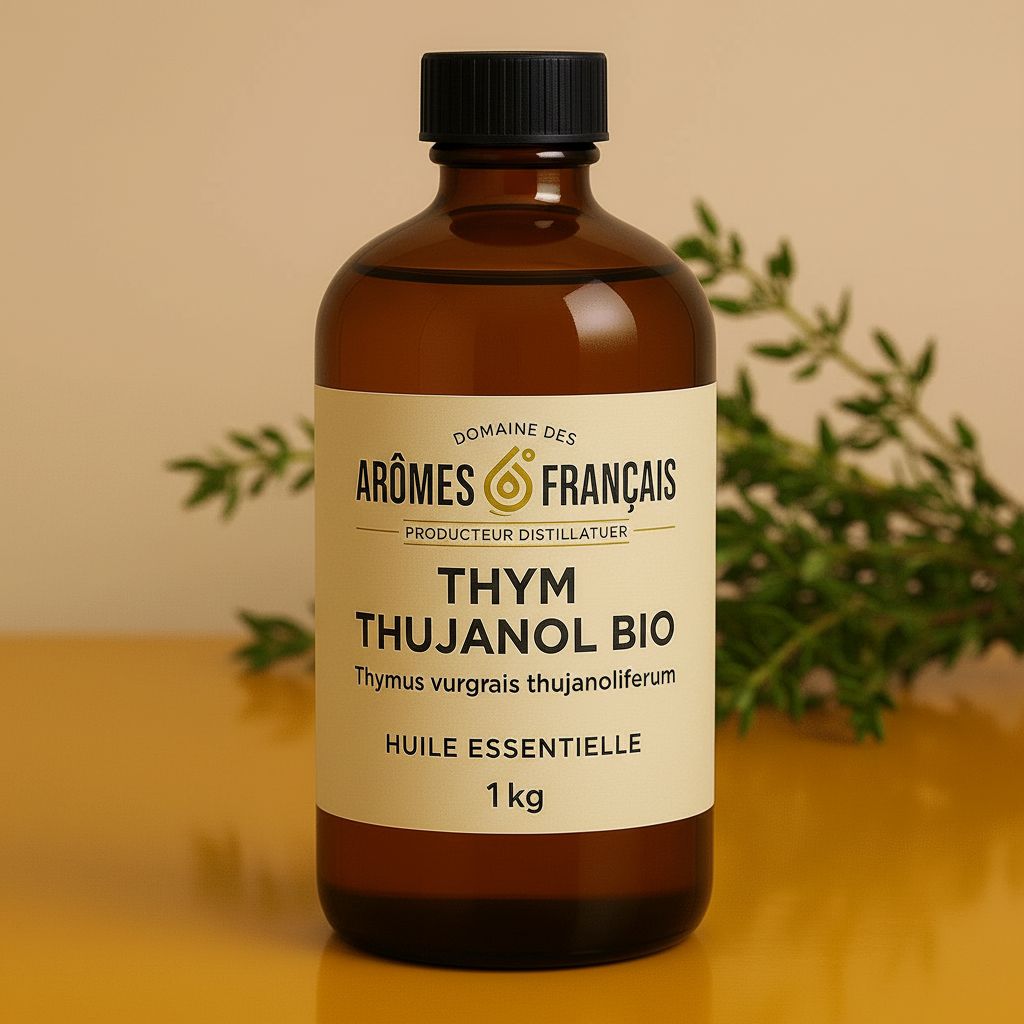
THYME THUJANOL

Need more? Please submit a custom quote request. We will get back to you within 24 hours.
Thyme thujanol essential oil is distinguished by its unique molecular profile dominated by trans-4-thujanol, conferring powerful antimicrobial properties and exceptional skin tolerance.
Unlike other thyme chemotypes, this oil combines therapeutic efficacy and gentle use, particularly appreciated in aromatherapy and cosmetic formulations.
A TRULY FRENCH ORIGIN
Grown in France, the plants from our producers are distilled either in the Drôme Provençale (fixed distillery unit), or directly in the harvest field (mobile distillery unit), then packaged in our warehouse in Isère.
Each batch is traced from the plot to the bottle, with analyses conducted by a French laboratory.
A LOCAL ALTERNATIVE
This locally grown plant can represent a relevant alternative to popular exotic essential oils.
Despite their natural origin, these can have a significant environmental impact (deforestation, pressure on biodiversity, carbon-intensive transport).
Here is an example:
Tea tree presents a very broad antimicrobial spectrum but can be irritating.Thyme thujanol offers targeted antimicrobial action with excellent skin tolerance, particularly suited to sensitive skin and children.
Please note: Each essential oil has a unique identity, and the same plant can also vary depending on its origin. The equivalences proposed here do not aim to fully replace exotic plants, but to explore complementary alternatives based on your needs.
This comparison is part of an approach to promote Made in France and Made in Europe products, while encouraging responsible use of oils sourced from fragile ecosystems such as Tea Tree or Ylang-Ylang.
Complete Plant Identity
QUALITY GUARANTEES
- 100% pure, natural, undiluted.
- Certified ORGANIC by Ecocert (FR-BIO-01)
- HECT (French chemotyped essential oil standard)
- Conform to EOBBD (Essential Oil Botanically and Biochemically Defined)
- Certificate of Analysis (CoA) included via Gas Chromatography/Mass Spectrometry (GC/MS)
PLANT CHEMICAL PROFILE
Safety Data Sheets (SDS) and technical data sheets are available in French only. For a personalised translation, feel free to contact us.
MOLECULAR PROPERTIES
WHO IS THIS oil FOR?

COSMETICS
- Incorporation at 0.5-1% in facial cleansers and masks for combination to acne-prone skin.
- Anti-dandruff treatment shampoos and stimulating lotions for irritated scalp.
- Healing creams and repair balms for sensitive skin, superficial wounds, and mild eczema.

PHARMACIES
- Syrups, lozenges and nasal sprays exploiting its gentle antimicrobial properties and excellent mucosal tolerance.

FOOD INDUSTRY
- Very limited use as a natural flavor in certain Mediterranean culinary preparations, always under professional supervision and at infinitesimal concentration (<0.01%).
AROMATHERAPY
- Diluted topical application at 10% in a carrier oil on the chest to clear respiratory pathways.
- Atmospheric diffusion combined with True Lavender (2 drops of each) to purify the surrounding air.
Usage guidelines
Not recommended for:
- Children under 7 years old
- Pregnant / breastfeeding women
- Epileptics
- Asthmatics
Essential oils are not without risks:
- Prior skin patch test recommended
- Never ingest undiluted without consulting a healthcare professional.
- Risks: allergy, convulsion, irritation, respiratory toxicity
Logistics
- 1 kg bottle: 24 × 9 × 9 cm
- 5 kg jerrycan: 28 × 18 × 23 cm
- 10 kg jerrycan: 32 × 23 × 29 cm
Please note:
Bulk orders are non-returnable, non-exchangeable, and non-refundable, except in the event of damage during transport.
If you suspect a quality issue with a bulk order, please contact our team within 30 days.
A 10 ml sample can be requested for analysis.
Any questions? Feel free to contact us:
+33 6 13 80 34 13
contact@domainedesaromesfrancais.com.
SHIPPING COSTS
France :
Mondial Relay : 14,95 €
Colissimo : 14,95 €
DHL : 24,95 €
Europe :
Mondial Relay : 15,95 €
Colissimo : 15,95 €
DHL : 25,95 €
SAFETY
Flammable, irritant, potentially toxic by inhalation or ingestion
Toxic to aquatic organisms


Sources :
The information presented above is provided for informational purposes only and cannot replace the advice of a healthcare professional.
- Akermi, S., Neffati, A., Ouerghemmi, S., Khouja, M. L., & Boussaid, M. (2022). In-depth study of Thymus vulgaris essential oil: Chemical profile, mechanisms of antimicrobial action and evaluation of toxicity. Plants, 11(7), 943. https://doi.org/10.3390/plants11070943
- Belgian FPS Health. (2023). Advice oral use of Essential Oils – Thymus vulgaris L. and Thymus zygis L. Service Public Fédéral Santé Publique, Sécurité de la Chaîne Alimentaire et Environnement. https://www.health.belgium.be/sites/default/files/uploads/fields/fpshealth_theme_file/eo_thymus_vulgaris_thymus_zygis.pdf
- Borugă, O., Jianu, C., Miulescu, G., Gruia, A. T., Horhat, F. G., & Mişcă, C. (2014). Thymus vulgaris essential oil: Chemical composition and antimicrobial properties. Natural Product Research, 28(9), 689-692. https://www.ncbi.nlm.nih.gov/pmc/articles/PMC4391421/
- Kowalczyk, A., Król, W., & Stepulak, A. (2020). Thymol and thyme essential oil—New insights into selected therapeutic applications. Molecules, 25(19), 4488. https://doi.org/10.3390/molecules25194488
- Myrtéa Formations. (2020). Monographie huile essentielle Thymus vulgaris thujanol [Fiche technique]. Aromathèque Myrtéa. https://www.myrtea-formations.com/modules/aromatheque/Fichiers_pdf/Monographies_longues/HE-Thymus_vulgaris_thujanol-200515.pdf
- Novotná, G., Kolarová, P., Vlková, E., Kott, T., & Ambroz, M. (2021). Thymus vulgaris essential oil and its biological activity. Plants, 10(9), 1959. https://doi.org/10.3390/plants10091959
- Schmidt, E., Wanner, J., Höferl, M., Jirovetz, L., Buchbauer, G., Gochev, V., Girova, T., Stoyanova, A., & Geissler, M. (2012). Chemical composition, olfactory analysis and antibacterial activity of Thymus vulgaris chemotypes geraniol, 4-thujanol/terpinen-4-ol, thymol and linalool cultivated in Southern France. Natural Product Communications, 7(8), 1095-1098. https://doi.org/10.1177/1934578X1200700833
- Wesołowska, A., Jadczak, D., & Grzeszczuk, M. (2019). Comparison of the chemical composition of essential oils isolated from two thyme (Thymus vulgaris L.) cultivars. Notulae Botanicae Horti Agrobotanici Cluj-Napoca, 47(3), 750-758. https://doi.org/10.15835/nbha47311451